


SPACETIME
Tomáš Pfeiffer’s Contemplation
Zezulka’s Creative Four creates spacetime, including the time sequence that we can call causality. This brings us to the subject matter of the book, which contemplates the relation between three- and four-dimensional space at its practical interaction in any part of The Creative Work.
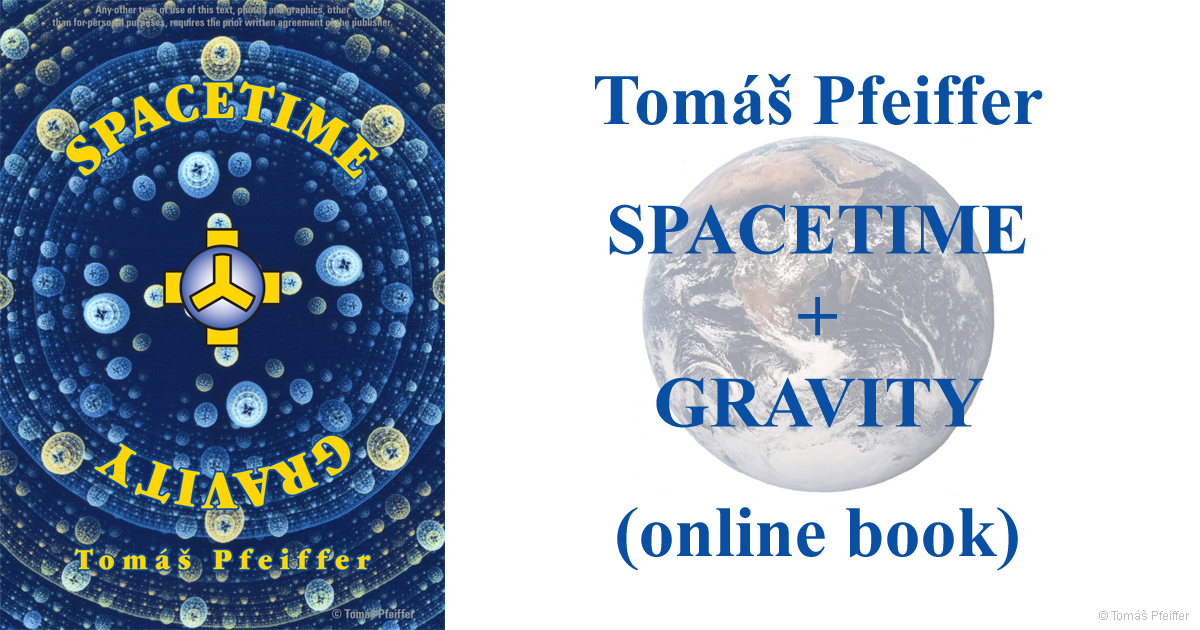
Fractal geometry is a very young field of mathematics. Its equations give amazing visual outputs. It is the geometry of infinity. The actual visual outputs of fractal geometry equations are also infinite (see the book cover), and as such they can be observed in all directions. That means it is possible to go infinitely through more and more details of the given fractal plane, and this always gives rise to another new image. Both in descending and ascending order. At the same time, they objectively manifest into finite three-dimensional structures that represent our understanding of the world. So far, we have been describing and measuring the world usually through the notions of three-dimensional rectangular linear Euclidean spaces, determining intervals along linear axes – we have been measuring. In fact, we are apparently situated in a curved spacetime (two straight lines intersect each other in infinity). This also has a major impact on the possibilities of understanding destiny as well as cosmic spacetime itself.

Figure 1 – Fractal image.
Is it not a mysterious beauty…?