


Chapter 2
The Philosophy of Existence
2.3 Quantisation of spacetime
2.3.4 Motion
The previous sections related time and space to motion. But what is motion?
Any kind of motion can be regarded as an action that connects time and space together. We usually relate motion to matter as an expression of a change in its position, shape, size or properties.
If we study motion philosophically, we find that what we perceive as motion is actually the event of dynamics being added to a static formation. It is our observation that adds the dynamics. We have already mentioned that our world and everything around us exists constantly; every possible manifestation, time, state and form exists simultaneously and is static. There was nothing, there will be nothing, everything “is” [1]. Our whole world is a static formation. Its existence does not depend on any observer – the observer does not create its existence, the existence IS.
It is our OBSERVATION that gives this world MOTION, as we connect to time and space at a certain point and perceive the existence of time and space as an oscillation (as described above in the sections Time and Space).
Our perception of MOTION, i.e. the dynamics of time and space, can be philosophically identified with OBSERVATION.
The physical quantity that characterises motion is velocity (with its magnitude – speed), which connects time and space together. The limits of the horizon of cognition are equally applicable to speed (see the illustration in the Fig. 2.5).
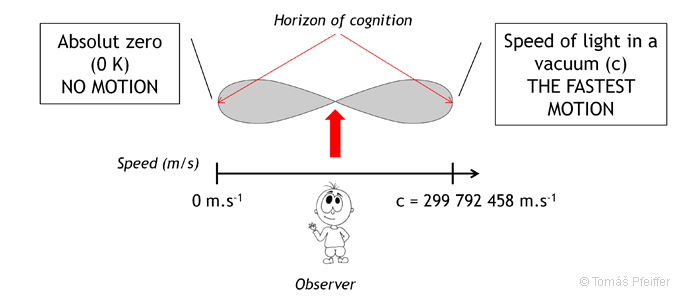
Figure 2.5: Limiting speed at the horizon of cognition. When we measure motion, we are on both sides limited by the horizon of cognition. We consider the highest measurable speed to be the speed of light in a vacuum (c), but the only way we could talk about zero speed (due to the permanent vibrational motion of all atoms and molecules), would be if the observed object reached a temperature of absolute zero (0 K) and simulataneously we did not consider the observer’s oscillation. It would be interesting to cool the observer (measuring device) to a temperature close to absolute zero and simultaneously observe just a single particle, i.e. to move the observer right up to the particle, into its spacetime. This way we would even be able to detect the oscillations of its subparticles and the boundaries of zero vibrations would be moved even further. This could continue to infinity.
Read more >>