


Chapter 2
The Philosophy of Existence
2.3 Quantisation of spacetime
2.3.1 The origin of spacetime
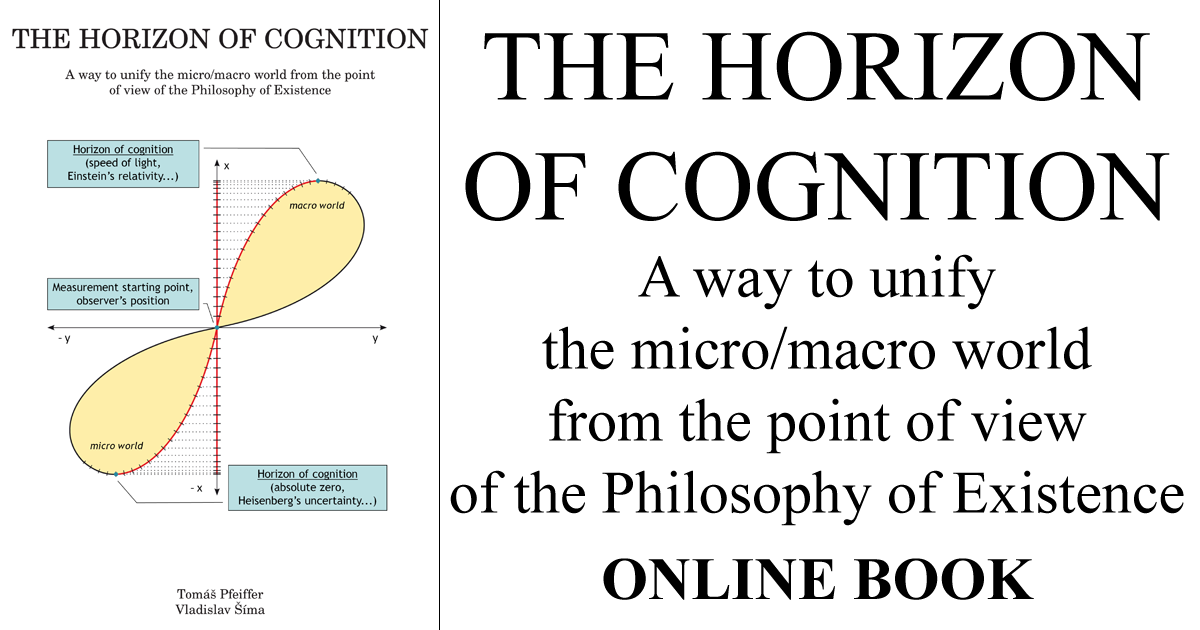
We can now consider the consequences of the horizon of cognition in greater depth. The horizon of cognition is a horizon beyond which nothing can be perceived, observed or measured without changing the observer’s position. We will show that this directly leads to the division of spacetime into mutually connected intervals – quanta (!).
In relation to this, we must first outline the philosophical understanding of some basic terms: time, space, interval and motion. To do so, we need to go all the way back to the origin of our world and the universe.
What does the Philosophy of Existence tell us about this? How did our world and the universe come into being?
When philosophically observing the origin of our world, we can see that everything that exists came into being through division. Imagine the beginning as a point Zero8 (zero state of time and space) that divides into opposite poles, as is illustrated in Fig. 2.3).
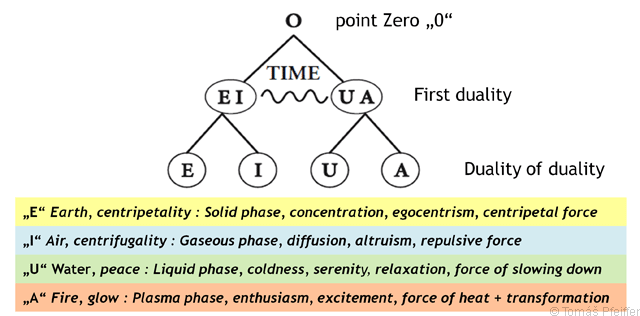
Figure 2.3: Point Zero „O“ divides creating spacetime [2]. Everything around us originated with the division of „zero state of space and time“ [1], [2]. The law of duality manifested itself in the way, that the first division created time and space, and the second division (the law of duality is valid also for the duality itself) created the 3D space we perceive. This is how the four poles of this double duality were created. We can consider these poles as the building blocks of our world. Ancient Greek philosophers, such as Empedocles [27], were familiar with them and called them fire (here A), water (here U), earth (here E) and air (here I). Note.: The forth dimension (which we are not able to perceive, was created by another mechanism, about which we will explain later.
The origin of our world through the process of division can also be described mathematically:
0 = (+1 − 1) + (+1 − 1)
Through the division of the point “0” (Zero), two pairs of forces (creative principles) are created. Each of these forces divided further into two forces (creative principles) of opposite poles. The grand total is still 0.
We can now think of time and space as a kind of “playground” which is a manifestation of the world’s four poles9 (E – Earth/centripetalism, I – Air/centrifugalism, U – Water/peace, A – Fire/glow). These four poles are the basic building blocks that are present in everything we know – so not only in material, the psyche or in forces but also in time and the world’s developmental sequences. The four poles are manifested in the world’s four dimensions (4D), of which we are able to perceive only three (3D).
The duality of everything is also related to matter. Nowadays, matter is generally considered to be the primary and defining phenomenon (for example, we regard the consciousness as a manifestation of highly organised organic matter, something that originates and disintegrates along with the matter; according to science, love is a biochemical reaction in the brain etc.). But in a dual word, matter necessarily and inherently also has a counterpart, an opposite. The counterpart to matter (which is manifested in the way we think and perceive) can be regarded as the building block(s) from which all thought structures and processes are built (philosophy would use the word “spirit”10 here). The nature of this “non-matter” is the same as matter, but has the opposite sign (a counterpart).
For example, with regard to matter we are familiar with inertia as a common property of physical objects (see Newton’s first law of motion), whereas its counterpart consists of traditions, customs and habits. They are essentially two poles of a single property, one expressed in matter, the other in “non-matter”.
Should only “Matter” and “Spirit” exist, our world would lack all dynamic time manifestation. Nothing would happen, change, or develop. Observations would not be possible either. This is why there is a third, power (vital11) part of our world, which pervades both matter and spirit, and gives them a rhythm, movement and vitality.
Matter, spirit and vitality are composed of the same four poles, the same basic building blocks or creative principles. The poles are always the same, they differ only how they manifest themselves, depending on whether they manifest themselves in matter, spirit or the power/vital activity. For instance, the “Earth” manifests in matter as solidity, a solid state; in spirit as a concentration, will, egocentrism, in power (vital) manifestation as a centripetal force, causing clustering, connecting, aggregating (imagine gravity, for instance). At the same time, all these are just different manifestations of the same, identical basic building block. Everything we know is thus comprised of the four building blocks (poles, creative principles) described above.
Stephen Hawking mentions the four basic building blocks in A Brief History of Time [4]: „... Aristotle’s theory that everything was made out of four elements – earth, air, fire and water, was simple enough to qualify, but it did not make any clear predictions.“
In order to be able to make true and certain predictions about the future based on the four elements, we need to develop the philosophical observations that we are sharing here into specific formulas and equations. This is however only possible if philosophy and science cooperate.
Let us summarize these basic principles once more. According to philosophical observations, the world we perceive originated through the division of the point “0”. Duality is therefore a fundamental and inseparable attribute of our world (as will be shown later, even gravity has a dual antipole). The four poles, creative principles, the basic building blocks of our world, originated from this division. They manifest themselves in the world’s matter, spirit and vital/power.
Science regards matter as the primary, initial, determining and therefore superordinate component of our world. The spiritual and power manifestations are only considered to be attributes and manifestations of matter.
Philosophical observation instead considers the three components to be equal. They have “a common nucleus and the same fundamental character. (. . . ). They blend with their activity and they are inseparable.” See [1], page 28. These components are: matter, spirit (which is basically the same as matter, just the opposite pole, like a mirror view), and finally vitality/power, which moves through and fills both spirit and matter, giving them life, i.e. making their manifestations dynamic.
Based on the knowledge that division was the origin of everything, we can try to comprehend the duality of all existence. The consequences of this duality are fundamental and also impact scientific knowledge.
Since division was the origin of everything that “is”, no single pole in this “is” can ever exist anywhere without the other pole (like magnets). And so nothing can exist without an opposite, a counterpart. Therefore, every scientific law, however valid and verified, must also encompass its negation and violation (or it would not have been able neither to emerge, nor or exist).
That fact that one pole cannot exist without the other is fundamental to understanding the symmetry of the world we live in.
In order to understand the “playing field” of our world – i.e. time and space (which is what we are discussing now), we also need to understand that a manifestation of any kind of dynamics (motion) in spacetime is connected to observation. Without observation, there is no motion, no time and no space. Everything that exists is static, and all and any dynamics are created by the observer (!).
And now we can move on to explaining the basic terms.
8 A “Zero” state of time and space is something, which cannot be described with current mathematics or science. Understanding it fully exceeds the capability of the human brain. Zero state does not mean that nothing exists – on the contrary, everything exists, but this everything is not being manifested. We can imagine (this is just a parable to help us understand) a very thin fan, folded up. So thin, that we cannot see or detect it with any means (i.e. it is invisible). In this state of a “folded fan”, neither time, nor space is manifested – they exist, but only in their “folded up” (= not manifested) form. This Zero state can also be referred to as the Podstata, see Josef Zezulka’s explanation in [1], page 7.:
“The Podstata is the fundamental timeless and dimensionless existence – it is the original nucleus, from which everything has arisen. The Podstata is the highest term and the basis of what we understand as reality as well as that which is not yet real for us – it defines sensory perception. Everything – both visible and invisible – is present within it.”
From this „Podstata“, “0” (Zero) point, a small part separated and started to divide. We can picture this as our imaginary folded fan unfolding. At this moment, it becomes possible to observe the fan, which also means that the great variety and diversity of our world is coming into existence. Our world is then thus called “The Creative Work” in reference to this. See [1], page 7.
9 These four poles, or creative principles, are called “The Creative Four” – Josef Zezulka [1], page 8. The Creative Four are manifested in matter, in the opposite of matter, which we can call “Spirit”, and in the vital (power) manifestation. See [1] for a more detailed explanation.
10 Our current science is not able to work with the notion of “Spirit”, which is not dependent on matter. This is perhaps due to the fact that “Spirit” can neither be measured, nor mathematically described. An explanation of ”Spirit” is found in [1], page 8:
„The Spirit forms the opposite of matter by the creative division of the principal part. The character of Spirit is mental. In the beginning, as an inorganic spirit, it stands out separately out from matter. Later, when favourable conditions occur on the planet, a small part of it unites with matter and the prevalent part remains inorganic. It is analogical with its antipole – the matter, where again just a small part of our planet’s matter is transformed into organic, while the prevalent part stays inorganic.“
Further, in [1], page 28:
„The spiritual component is most similar to the term we know as thinking – psyche – the mind. It is the part that created, and in the course of our time still creates, events, shapes, situations and psychic forms (. . . ). It manifests itself in forms of being as thinking. It is the spirit that is a plan of everything that exists.”
11 See [1], page 29:
„The third component is vital. It is the vital force that moves through spirit and matter. It is the oscillation of life – rhythm, that is coincidented by its existence in the Creative Work. This is because it is dependent on time, which doesn’t exist in the Proto-podstata. (. . . ) It is an agent of processes and procedures; it is the vital force.”
Read more >>